

Regulation Should Not Become a Barrier & Financial Burden
Jammu and Kashmir needs an unambiguous policy, one uniform procedure and a legally compliant digital system. The Transport Department has the responsibility to regulate vehicles. But the Government has an equally important responsibility: to ensure that its regulatory machinery works in accordance with the law, not around it.
For an ordinary vehicle owner, bringing a car from Delhi, Chandigarh or Haryana to Jammu and Kashmir should not become an arduous journey from one government counter to another, and ultimately from the RTO office to the High Court. Yet that is precisely what appears to be happening with the demand for 9 per cent road/token tax on vehicles already registered and taxed outside Jammu and Kashmir.
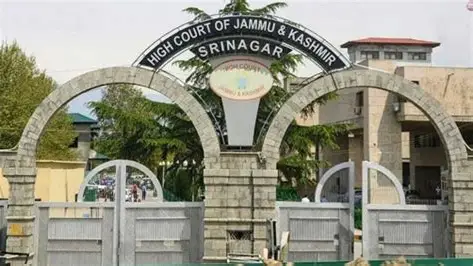
The issue has once again come under judicial scrutiny in Mohammad Maqbool Mir and Another versus Government of J&K (Transport/RTO) and Others, WP(C) No. 1575/2026, which came up before the High Court of Jammu and Kashmir and Ladakh in Srinagar on July 8, 2026.
The petitioners, represented by the writer, had approached the Court seeking assignment of new J&K registration marks to vehicles bearing outside registration numbers. They relied upon the judgment in Zahoor Ahmad Bhat versus Government of J&K and Others.
The Court disposed of the petition by directing the ARTO, Pulwama, to consider and decide the applications within one month. The order was limited to disposal of the applications. But the controversy behind it is much larger.
The Department defended the demand by relying on Section 3 of the J&K Motor Vehicles Taxation Act, 1957, contending that the 9 per cent levy was a road/token tax on vehicles using J&K roads. It argued that Zahoor Ahmad Bhat had not declared Section 3 “unconstitutional” and was confined to the legality of the administrative circular and the assignment of a new registration mark.
The Zahoor Bhat Judgment Changed the question. The story goes back to the Zahoor Ahmad Bhat case, decided by a Division Bench of the High Court on April 29, 2021.
The dispute arose after the Transport Department sought to require owners of vehicles registered outside J&K to obtain new registration marks and pay 9 per cent tax. The High Court drew an important distinction that assignment of a new registration mark is not the same as fresh registration of a vehicle.
Under Section 46 of the Motor Vehicles Act, 1988, registration granted in one State is valid throughout India. Section 47 provides that where a vehicle registered in one State is kept in another State for more than twelve months, the owner has to apply for assignment of a new registration mark. The vehicle, therefore, does not become a new vehicle merely because its registration mark changes.
The Division Bench held that where lifetime tax had already been levied and paid at the time of registration, that lifetime tax could not simply be levied again merely because the vehicle had moved to another State or a federally administered territory and remained there for more than twelve months.
The High Court made it clear that the authorities retained the power to verify the genuineness of vehicles and documents.
Predictably, the Government challenged the matter before the Supreme Court.
In August 2023, the Supreme Court dismissed the Special Leave Petitions on the ground of delay. Yet the controversy did not end there.
In Ishfaq Ahmad Tramboo versus J&K and Others, the same question came before the High Court again.
The petitioner owned a vehicle registered in Gurgaon, Haryana. When he sought assignment of a J&K registration mark, the Transport Department demanded 9 per cent of the vehicle’s declared value—around Rs. 4 lakh—as a condition for processing the application.
The Department defended its demand by relying upon Section 3 of the J&K Motor Vehicles Taxation Act, 1957, contending that the tax was a road/token tax applicable to vehicles using roads in J&K.
This distinction is important and deserves serious consideration. Zahoor Ahmad Bhat case did not declare Section 3 of the J&K Motor Vehicles Taxation Act unconstitutional. The Department’s argument has been that the earlier judgment primarily dealt with the legality of the administrative circular and the mechanism for assignment of a new registration mark.
But the difficulty is that the High Court subsequently considered this very defence in Ishfaq Ahmad Tramboo case.
On August 9, 2024, Justice Javed Iqbal Wani allowed the petition and directed the authorities to assign the J&K registration mark under Section 47 of the Motor Vehicles Act without demanding 9 per cent token tax. The Court’s direction was unequivocal.
This makes the continued recurrence of the dispute particularly troubling.
There is, of course, nothing wrong with the Transport Department scrutinising vehicles entering J&K. It must verify documents, chassis and engine numbers, ownership, insurance, NOCs and the genuineness of registration.
The High Court itself has preserved these powers. The problem begins when regulation becomes an additional financial barrier or burden, which courts have already found unsustainable in the circumstances under consideration.
For an ordinary citizen, the consequences are considerable. Take a vehicle worth Rs. 5 lakh. A 9 per cent demand means Rs. 45,000. On a Rs. 10 lakh vehicle, it becomes Rs. 90,000. For expensive vehicles, the figure can run into several lakhs. And the citizen is effectively left with two choices: pay the demand or litigate. That cannot be the objective of citizen-centric administration.
The impact is even greater on the second-hand or used automobile trade. Dealers frequently source vehicles from outside J&K. A vehicle purchased in Chandigarh or Haryana may be perfectly legitimate, properly registered and already taxed. If another substantial tax demand is suddenly imposed when the vehicle is brought to J&K, the cost of the transaction changes dramatically.
Inventory becomes expensive. Capital gets blocked. Sales are delayed. Customers become uncertain. Dealers face additional compliance burdens.
Indeed, J&K needs regulation. But businesses also need regulatory certainty.
Government portals cannot become a source of law. Another issue that deserves urgent attention is the technology through which the department implements or invokes the law.
It is reliably learnt that the Transport Department’s portal does not presently provide an effective mechanism for processing vehicles falling within the category where the 9 per cent demand is not applicable pursuant to the judicial decisions. It is further learnt that the department has approached the National Informatics Centre for incorporating the required technical facility.
If so, the matter needs immediate intervention. A government portal cannot become a source of law. If the law, as interpreted by the court, permits an eligible vehicle to obtain a new registration mark without payment of the disputed 9 per cent tax, the online system must provide a mechanism to process that application.
A technical limitation cannot override a judicial direction. The Government therefore needs to move beyond case-by-case litigation.
From litigation to policy reform, the Transport Department, Law Department, Finance Department and NIC should jointly prepare a SOP for vehicles entering J&K from outside. The procedure should distinguish between temporary visitors, vehicles remaining beyond twelve months, transfer of ownership, assignment of a new registration mark and cases involving fraud or defective documentation. The portal should then be redesigned to reflect that policy.
Most importantly, the Government should issue uniform instructions to all RTOs and ARTOs so that similarly situated citizens are not treated differently in different offices.
This is also where the political class has an important role. The issue should not be reduced to a confrontation between citizens and transport officials. MLAs, political parties, automobile associations, traders and civil society can legitimately demand clarity from the Government.
The question is not whether the Government should collect legitimate taxes. It unquestionably has the power to do so where authorised by law. The real question is simpler: Can a citizen who has already paid lifetime tax on a vehicle in another State be asked to pay another 9 per cent merely because the vehicle requires a new registration mark after being brought to J&K?
The Mohammad Maqbool Mir case should therefore become an opportunity for policy correction rather than another chapter in recurring litigation.
Ultimately, the 9 per cent tax controversy should make one ask whether an ordinary citizen has to be forced to knock on the doors of the High Court to make an administrative system follow the law. That is a question deserving a policy answer, not another writ petition.
(Hamid Rather is a lawyer, policy consultant, practicing law at the High Court of Jammu & Kashmir and Ladakh)