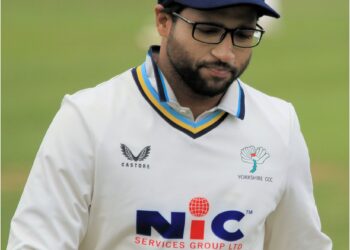

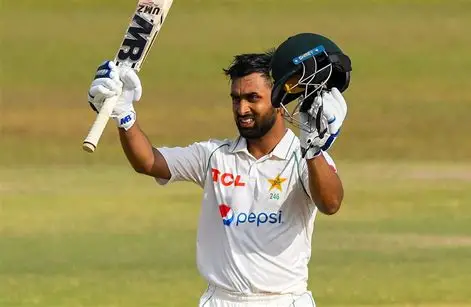

Abdullah Shafique’s unbeaten 160* in the second and final Test match against the West Indies at Queen’s Park Oval felt like a proper statement of intent. Shafique made a statement after coming in as an ‘emergency replacement’ after Shan Masood fractured his finger. He walked out at number three to bat after months out of the side.
He produced a calm, classy knock of 160 off 323 balls with 15 fours and three sixes. Pakistan finished their innings on 387 and took a 43-run lead, and Shafique carried his bat through the innings. It was his sixth Test hundred and the first since October 2024.
What made it more impressive was the context. He had not played a Test for Pakistan since the South Africa series at home late last year. Poor form had pushed him out of the contention. He missed the Bangladesh tour and was not even in the original squad for the West Indies series.
In his previous 35 Test innings before this one, he had failed to reach a score of 20 on 25 occasions. Getting a start had become the real problem. Once he got past 45, though, he often converted those starts into big scores at a decent rate. The talent was never the issue. Consistency was.
Shafique’s early years had promised so much. He debuted in 2021 and quickly looked the part of a proper Test batter, with compact technique, elegant strokeplay, and the temperament to stay long at the crease.
His unbeaten 160* in Galle in 2022 remains one of the best chases by a Pakistani in recent memory. He faced 408 balls and helped the side hunt down 342 against Sri Lanka on a turning track, the highest successful chase at that ground. He also has a double century against Sri Lanka in Colombo.
There were strong knocks against Australia and England too, and for a while he looked set to become one of the fastest Pakistanis to 1000 Test runs.
The numbers tell the story of both the promise and the dip. Around 25 Tests, close to 1700 runs at an average in the high 30s to low 40s, with six hundreds.
In ODIs, the returns have been more modest, averaging around the 29 to 32 mark with one century. First-class cricket still shows a healthier average in the mid 40s. The early peak, when he averaged close to 47 or 50, stands in clear contrast to the leaner stretch from 2024 onward, when averages slipped into the mid teens for periods.
Selectors had their reasons for being cautious, yet the underlying quality never really left him. What stands out about Shafique among recent Pakistani batters is how correct and balanced he looks.
Compact at the crease, high control, textbook method, as Babar calls him “Kitabi” [copy book, technical batter] that travels well.
He handles pace by getting on top of the bounce and driving cleanly. Shafique plays spin with equal ease, using his feet, sweeping, and lofting when the opportunity arrives, as he did against J Warrican in Port of Spain.
The control that Shafique exhibited in that innings was the highlight, prompting batting coach Asad Shafiq to shower praise on the batter. The way he put away the loose balls while respecting the good ones. That his domestic form had been strong before the call up, and it showed.
These are not flashy attributes. They are the foundation of a long format anchor, the kind of batter who can build partnerships, as he did with Babar Azam in that solid third wicket stand, and turned starts into match defining scores.
Outside Babar and Rizwan, Pakistan’s batting depth has often looked thin. Giving a player with Shafique’s floor and ceiling regular opportunities makes sense.
Looking ahead, when the post Babar-era eventually arrives, batters of Shafique’s profile will need to take on more responsibility. He has already shown he can win Tests, Galle 2022 is proof of that.
The same technical base can transfer to ODIs with better intent and strike rotation. Dropping or rotating a player of this kind purely on short-term form risks wasting years of development, especially when the alternatives are less proven.
Form dips are real and need managing. There were clear struggles against the new ball and incoming deliveries during the lean period, and some observers noted occasional issues with stance and footwork against spin. Yet the response in Trinidad, adapting to number three, handling Caribbean conditions after recent red ball practice, and producing a marathon effort, showed the talent is still there.
Pakistan has a habit of letting high ceiling players drift. Shafique’s roar when he reached his century carried both relief and a reminder of what is at stake.
The case for more consistent selection in Tests and ODIs is straightforward. Pakistan needs batters who look solid against both pace and spin, can score big hundreds, and can win longer format games. Abdullah Shafique is one of the few who fit that description. His score of 160* not out was not some random miracle. It was a timely reminder of the player Pakistan already has, provided the system keeps faith long enough for the high ceiling to turn into consistent performance!
(The author is an independent content writer and blogger. As a cricket aficionado, he often writes about the game. He can be reached at bilalahsandar@yahoo.com.)