
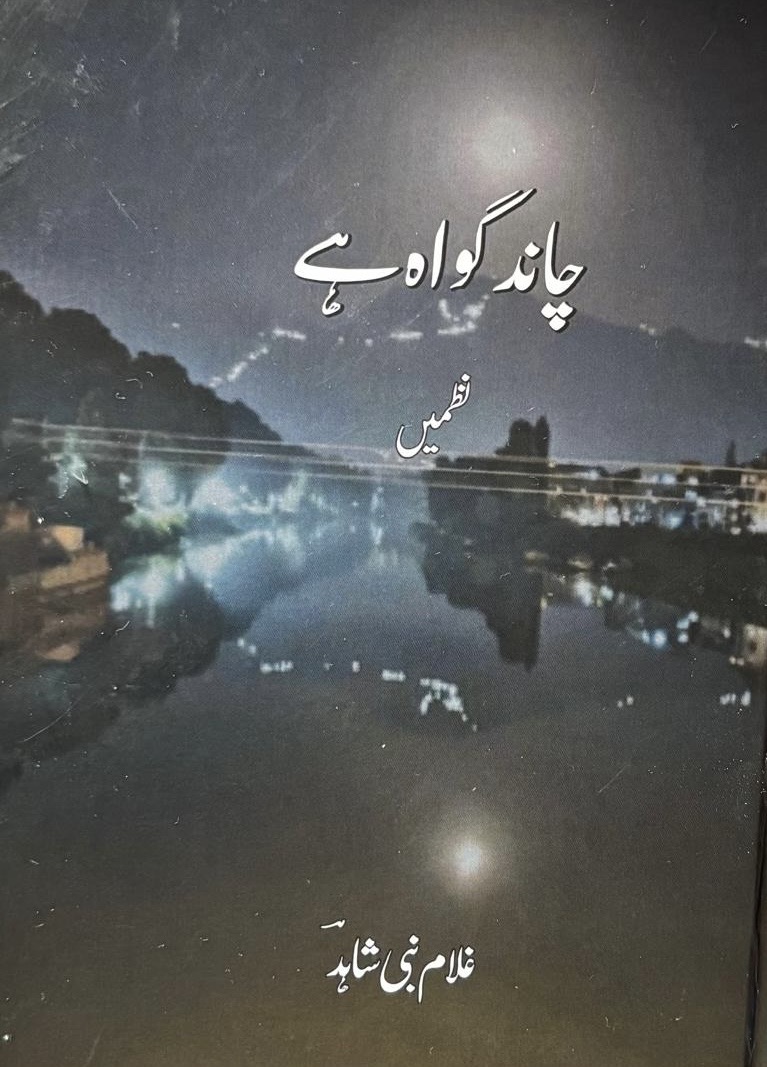
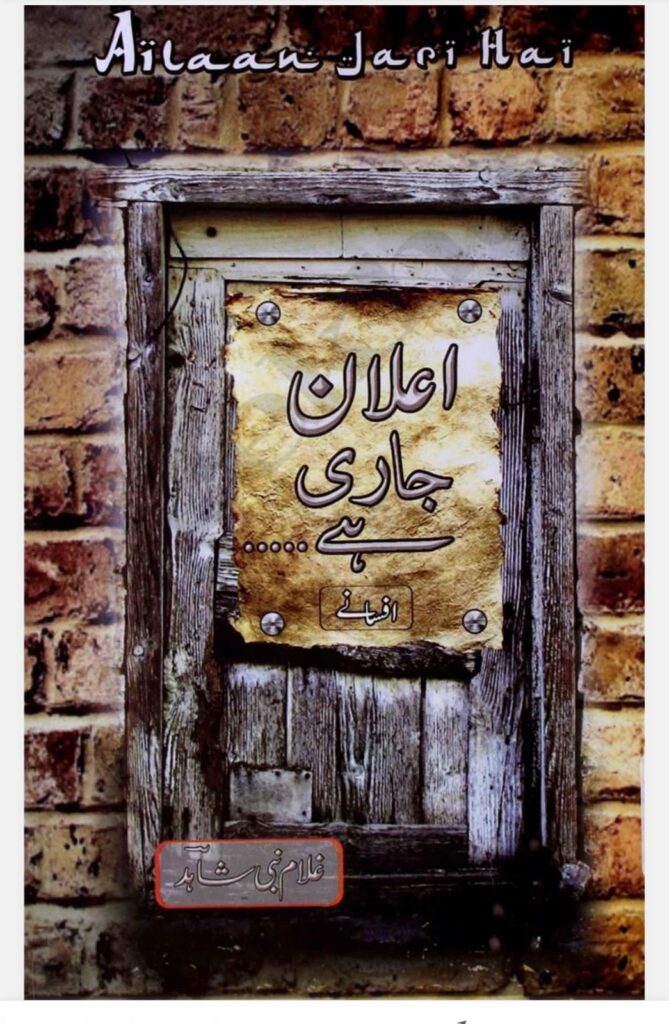
Ghulam Nabi Shahid’s ‘Chand Gawah Hai’ & ‘Eelan Jaari Hai’
Srinagar 08 July: Distinguished short-story Kashmiri writer Ghulam Nabi Shahid’s “Chand Gawah Hai” (The Moon Bears Witness), a collection of prose poems, is unputdownable.
All the 69 poems revolve around various themes, including memory, loss, ordeal, resilience and violence. It was published in 2025.
Shahid, the Srinagar-based writer, gained immense popularity for his collection of short stories titled “Eelan Jaari Hai” (Announcement is in Progress). It was published in 2013.
The writer had dedicated the book to Dilip Kumar Nehru.
His latest body of work is dedicated to a railway coolie, Gurmeet Singh.
What makes Shahid’s work attractive is his brevity.
Shahid’s latest work establishes him as a genuine thinker who feels the pulse of his people and society. As a vigilant observer, he captures the essence of whatever happens around him.
Rafiq Raz, a renowned Kashmiri poet, in praise of Shahid’s latest collection of prose poems writes: “Most Urdu writers from Kashmir are fans of ghazal writing. Ghulam Nabi Shahid, who is essentially a short-story writer, has now used prose poems as a medium of expression. It is a welcome development. There is intellectual harmony in his work.”
In all 23 short stories of “Eelan Jaari Hai”, the writer packs a punch.
For readers, we have translated a couple of Shahid’s short stories:
‘JAWAAB DO’ (ANSWER ME)
Heads lowered, in groups of two or three, they are holding placards and marching silently towards the park located in the heart of the city. They have assembled here on the 10th of every month for many years to protest. Right in the middle of the city, and between two bustling markets, this park is a centre of attraction for its beauty and romantic atmosphere, especially during summer. To one side, facing the main square, a hoarding was erected just near the Chinar tree, about three feet inside the park’s iron fence. On it, as a backdrop, the Valley’s charm, its beautiful hills, waterfalls, streams and lakes were etched with such deftness and dexterity that every passerby could not resist looking at the hoarding over and over again.
These people in small groups enter the park and assemble near the big Chinar tree facing the main square. With her fatigued eyes, Khadeeja too looks at it with a placard in her hand. To her, the shade of the Chinar appears like deep black smoke. Moving away from it, Khadeeja proceeds toward the hoarding; her back resting on one of its pillars. As the event begins, all the people assembled in the park pick up their respective placards to stage a demonstration. The pedestrians don’t move an inch, their eyes fixed on the demonstrators. They look at them with a sense of dispossession and helplessness. The protests continue. Khadeeja looks at the people. She gathers some courage slowly; she stands up and lifts her placard towards the sky with her trembling hands…
The assembled crowds on the road fix their eyes on the upright hoarding, on which the following lines are inscribed:
‘agar firdous barooye zameen ast
hameein ast o hameein ast o hameein ast’
(If there is paradise on earth
it is here, it is here, it is here)
Right below this verse, is Khadeeja’s placard: ‘Mera Firdous kahan hai?’ (Where is my Firdous?
(Firdous, the name of Khadeeja’s son which when translated into English means Paradise)
Baazyaaft (Discovery)
Since Asr prayers before dusk, there was a lot of activity inside Ahad Lone’s house, situated close to a mosque in the mohalla. Neighbours were somewhat perplexed at the commotion. As the time for Maghrib (evening) prayers arrived, speculations over the new developments in Ahad Lone’s home were rife.
Along with his neighbours, Ahad Lone came out of the mosque after offering mandatory Isha (late evening) prayers. On finding him somewhat contented and relaxed, they asked him, ‘Ahad Lone, what’s the matter? Did you get any news about Aslam?’
‘Yes,’ Ahad Lone said self-assuredly after a brief pause.
‘Where is he, when is he coming, has he returned already?’ asked one of the neighbours emotionally.
‘No, Aslam is not returning,’ said Ahad Lone, with the same poise. ‘His grave has been discovered.’