

What a stretch of Srinagar’s Ali Jan Road Reveals About Road-cutting, Restoration & Accountability …
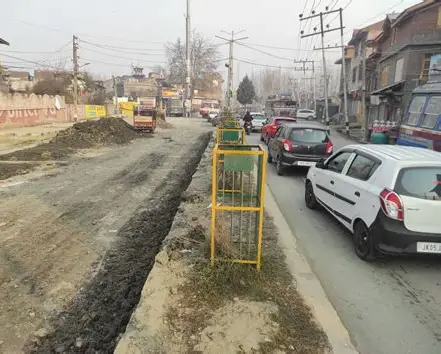
A stretch of Srinagar’s famed Ali Jan Road leading towards the Sher-i-Kashmir Institute of Medical Sciences [SKIMS] tells a familiar story about the city’s roads: excavation is completed, but the restoration becomes someone else’s problem.
The road was dug up several months ago for underground utility work. The work beneath the surface appears to have been completed, but the affected carriageway remains inadequately restored. The trench appears to have been backfilled with excavated material, leaving an uneven surface with depressions, loose aggregate and scattered stones.
That might be dismissed as a minor inconvenience on an ordinary street. It is harder to do so on a road leading to one of the region’s major tertiary-care hospitals. For an ambulance carrying a trauma victim, a cardiac patient or someone in severe pain, every stretch of the journey matters. Dr Ali Jan must be turning in his grave.
A rough and uneven carriageway can subject patients to unnecessary jolts and make their movement more difficult. Access roads to major hospitals should, therefore, be treated as critical infrastructure, not as routine stretches of the city’s road networks.
Yet the problem is not that the road was excavated. In a growing city, such work is unavoidable. Water supply, sewerage, electricity, telecommunications and other utilities must periodically be laid, repaired or upgraded. The real test of administration begins after the excavation.
A road is an engineered structure, with its subgrade, sub-base, base course and wearing course designed to work as a single system. Once a trench is cut through it, that structure is disturbed. Filling it with excavated earth and loose material cannot, by itself, restore the pavement to its original condition.
Proper reinstatement requires suitable backfilling, controlled compaction in layers, reconstruction of the sub-base and base course, and a properly laid bituminous surface tied into the existing carriageway.
If these steps are skipped or poorly executed, settlement, cracking, rutting and potholes can follow.
This raises a more fundamental question: who is accountable for putting the road back in order?
Before a public road is opened, there should be clarity on who has permission to cut it, what restoration standards must be followed, when the work must be completed and who bears the cost. There should also be a clear mechanism for inspection and certification after the completion of the restoration work.
Was permission for the Ali Jan Road excavation granted with specific restoration conditions? Was a deadline prescribed? Was a security deposit or restoration charge obtained? Which agency or contractor was made responsible for reinstatement? And who is required to certify that the restored road meets the prescribed standard?
These are rudimentary questions of public-asset management. Excavating a road for legitimate public utility work does not transfer ownership of the road or responsibility for its condition to nobody.
The Roads and Buildings (R&B) Department has an important role in ensuring that responsibility does not become blurred among government agencies, utility departments and contractors. If a utility agency is responsible for restoration, compliance must be monitored. If reinstatement falls to the R&B Department, delays should be accounted for.
The principle is simple: the completion of underground work cannot be the end of the project. The project should end only when the road has been properly restored and the restoration has been inspected and certified.
There is also a question of timing. Road reinstatement is best carried out under conditions that allow proper compaction and pavement laying. Prolonged delays can push the work into unfavourable weather and compromise durability. If restoration cannot be completed within the prescribed period, the reason should be known and the revised timeline made clear.
The Ali Jan Road stretch may not be an isolated example. Similar cases of roads being cut, temporarily filled and left awaiting proper restoration have been seen elsewhere in Srinagar, including stretches of Mirza Kamil Sahib Road in Hawal.
If such practices are recurring, they point to a weakness in the system rather than an isolated failure. That weakness becomes more serious as Srinagar grows more congested and its underground utility networks expand. The city has limited road space, rising traffic volumes and little margin for prolonged disruption.
Better coordination between agencies is, therefore, no longer optional. One relatively simple reform could help, a centralised register of all authorised road cuts. It could record the agency responsible, date of excavation, purpose of the work, restoration deadline, responsible contractor or department, inspection status and date of final certification. Standard restoration specifications could be prescribed according to the category and importance of each road.
Such a system would create something often missing in public works , a visible chain of responsibility.
For Ali Jan Road, the immediate task is uncomplicated. The affected section should be inspected, the agency responsible identified, the original road cutting conditions examined and the restoration completed to the required engineering standard. There is little justification for allowing a hospital approach road to remain in a compromised condition for months after the utility work has apparently been completed.
The larger issue, however, goes beyond one road. Every time a public road is excavated, public money and public convenience are at stake. Poor reinstatement shortens pavement life, increases maintenance costs, disrupts traffic and shifts the burden of administrative shortcomings onto ordinary citizens.
Srinagar cannot avoid road-cutting. It can, however, avoid administrative indifference after the cutting is done. A hospital road should represent the shortest and safest possible link between a patient and medical care. It should not become a reminder of what happens when responsibility is divided, supervision is weak and restoration is allowed to drift.
The road to SKIMS should lead to care not to another dead end of administrative accountability.
(The author, a civil engineer by profession, has worked in various capacities with J&K Government, including executive engineer PDD. He can be reached at fazalqari3@gmail.com)