

Escaping Accountability & Indulging in Whataboutery
A professional journalist or a broadcaster will never have it easy. S(he) is often caught between competing and conflicting narratives of those in power and the ones in opposition. In Kashmir, a professional journalist has a double-edged sword hanging on head all the time.
At a cursory glance, one would see ‘journalism’ platforms proliferating, influencers and YouTubers out there on the street with a microphone and non-stop commentary with passionate requests of following their page, subscribing their channel, liking their content and commenting on the same. This noise is their revenue model.
This is a telling comment on the reading choices that subscribers make for themselves. Instead of a professional journalist making sense of sociopolitical events in an unbiased, unprejudiced and professional manner, without exaggeration and hyperbole, there is, unfortunately, preference for noisemakers and unprofessional content-making industry.
The competition, it so seems, is between the one who shouts and the one who shouts and screams at the top of lungs and who can also hurl a choicest invective or two.
On the other hand, the reporters who go through the grind, work on a particular story for weeks, cultivating sources and dealing with objective facts, find no appreciation for their work. Their content is less shared, less commented upon.
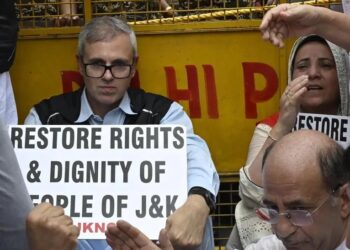
Another upsetting trend is how the ruling party, presently the Jammu and Kashmir National Conference [JKNC], accuses professional journalists of writing their stories against the ruling dispensation.
Their argument is that the opposition, the People’s Democratic Party [PDP], also did some wrong acts from 2002 to 2008, and 2015 to 2018. As if two wrongs make a right!
Another bizarre argument from the JKNC spokespersons is that why don’t journalists write against New Delhi or the New Delhi-appointed Lieutenant Governor. As if the LG administration has won 42 seats in the 2024 Legislative Assembly elections.
The ruling party’s spokespersons also entertain social media influencers and offer them sound bites and interviews, knowing fully well that no hard questions will be asked. Such interactions remain performative and controlled.
The JKPDP also wants to keep professional journalists away and speak to those who own Facebook pages. It is easy to manipulate unprofessional content creators who ask them questions about their daily routine, marriage plans and the pets they love to have.
Whether the JKNC or the JKPDP, the modus operandi remains the same. Maintain safe distance from professional journalists and keep them at bay.
If one asks them questions about their leader’s controversial remarks, their argument is why don’t you write about the alleged 3,000 detentions.
This whataboutery from both the ruling party and the opposition is nauseating, to say the least. They have a sort of understanding or MoU to keep journalists away as much as possible.
Additionally, other smaller parties make similar arguments why don’t you question the ruling party or the one which was governing the state of Jammu and Kashmir earlier. The ugly pattern is to avoid accountability and instead indulge in whataboutery.
In such a scenario, a professional journalist finds herself/himself sandwiched between competing narratives, whataboutery and performative politics.
It is not a cakewalk for a journalist to report from Kashmir, especially when there’s hostility from all sides. The choice has reduced between the devil and the deep blue sea.
That said, a professional journalist will keep asking questions and holding power to account, whenever possible.