

Muhammad Mukaram
When the National Conference [NC] vice-president Omar Abdullah took oath as Jammu and Kashmir’s Chief Minister on October 8, 2024, voters in the entire region hoped that it would bring relief to their pressing issues which they had been facing for years, especially after the withdrawal of Article 370 on August 5, 2019.
Given the promises made by the NC in its highly publicised manifesto for the 2024 Assembly polls and the fiery speech made by Omar Abdullah, the expectations of the electorate grew manifold.
The elected government will soon be completing its two years in office, yet that hope among voters has faded away and the ruling dispensation has brought more disappointment among them due to deficiency in governance.
Not a single promise of governance that the NC made during the 2024 polls has yet been fulfilled. Leaving aside the tall promises of the restoration of statehood and special status, the party has not even delivered two units of free electricity when it had promised 200 units; no free LPG cylinders or one lakh jobs either.
In the last two years, what the voters are instead witnessing is the reels of legislators, decorated with background music; the cabinet ministers have understood what sells in this digital age and how the social media algorithm operates.
If the government didn’t provide one lakh jobs, as promised in the party manifesto, its MLAs have employed creative reel makers and opened social media accounts in bulk.
The role of the Opposition, particularly the PDP, Peoples Conference and the Apni Party in the Kashmir Valley is too glaring. Instead of questioning the government on its manifesto and governance, they are busy organising press conferences in response to press conferences. Every other hour, people are witnessing social media pages flooded by soundbites of politicians representing various ideological hues.
Press conferences are the new currency. Noise is the new political narrative.
Some politicians are delivering weekly presentations and speeches from their kitchen studios. They are the new-age influencers.
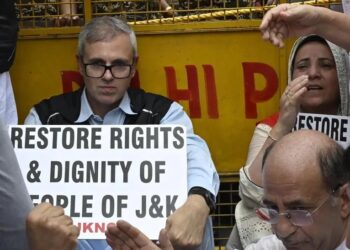
The latest Delhi episode, protests for the restoration of statehood, is one such issue that shows how performative politics cannot withstand and be an alternative to delivery on the governance front. The shelf life of performative politics is short.
A recent “banta hai” remark made by the former Chief Minister and PDP president, Mehbooba Mufti, as an opposition leader, offered new ammunition to the ruling party for about a week. Instead of cornering the government on real issues, the opposition was itself cornered until it sulked and regretted the controversial statement.
Although using social media as a medium to disseminate information,statements and soundbites is not objectionable. Making it the only information tool is problematic in more ways than one.
Some politicians in Kashmir have understood that facing tough questions from professional journalists is not a cake walk, so they invite social media influencers to interview them about their pets, marriage plans and favourite cuisine. Or, they themselves assume the role of social media influencers.
The issue with social media politics is that it dissipates within half-an-hour. You raise an issue on social media, it creates outrage in the virtual world, then it goes off. The next moment is overshadowed by a new issue or a new reel.
The Kashmir-based parties must stop relying on performative spectacle. Although it gives them a daily escape, they can’t deceive their voters for long.
Instead of playing the Press Conference versus Press Conference game, the opposition parties must hold the ruling dispensation to account on governance delivery.