

Srinagar: July 15: A famous quote is attributed to India’s former National Security Advisor (NSA), Brajesh Sharma. In his book, Kashmir: The Vajpayee Years, India’s former spymaster Amarjit Singh Dulat notes that, before heading to Kashmir, he was told by then NSA Mishra that “There is nothing straight in Kashmir except poplar trees”.
One is at liberty to either believe in this statement or categorically dismiss it. Regardless of one’s choice, there is often a backstory, subtext and context involved in complex issues which require nuanced understanding and also the ability to read between the lines.
This approach will help understand the role played by the Jammu and Kashmir National Conference, the region’s oldest political formation, which was formed in 1939.
After the events of August 1947, the JKNC has craftily adopted a stick-and-carrot policy. As author and academic Chitralekha Zutshi notes in The Caged Lion of Kashmir, Sheikh Mohammad Abdullah would say one thing in Srinagar and quite another in New Delhi. Sheikh Abdullah’s successors, Farooq Abdullah and Omar Abdullah, have taken a step forward and perfected the art of saying one thing in Srinagar, another in Jammu, yet another in Delhi, and making a different statement for international audiences.
Similarly, to keep its vote bank intact, the party uses emotive rhetoric and chooses a firebrand speaker to make a lot of noise. The party knows that the noise keeps the cadre in good humour. On the political turf, the party adopts a pragmatic approach and does not annoy New Delhi by any stretch of the imagination.
The News Herald brings to you three JKNC personalities who have, at various junctures of the region’s history, kept the people emotionally hooked by political rhetoric and performative politics.
Earlier, it was Sheikh Nazir Ahmad. Nazir, the JKNC veteran who passed away in 2015, served as the party’s powerful general secretary. As a nephew of the party’s founder Sheikh Mohammad Abdullah and Omar Abdullah’s uncle, Sheikh Nazir Ahmad earned his reputation as a “hardliner”. He was largely seen as a strong votary of Jammu and Kashmir’s internal autonomy and Kashmiri nationalism.
Sheikh Nazir would not shy away from disagreeing with his own party’s stance whenever he felt the JKNC made a compromise. He wasn’t seen much publicly and avoided media attention and the limelight. But he still managed to attract attention because of his “hardline” stance on issues such as regional autonomy, special status, semi-autonomy and Kashmiri nationalism.
Incidentally, Sheikh Nazir Ahmad was born at a time when Jammu and Kashmir witnessed its biggest political awakening in 1931.
After his passing in 2015, Sheikh Mustafa Kamal, the brother of Farooq Abdullah, took it upon himself to be seen as a hardliner in the party. The outspoken Kamal would embarrass his own party, at times, by differing with the line adopted. Farooq Abdullah had to take the harsh step of removing him from the post of additional general secretary and party spokesperson.
Kamal passed away in Srinagar on 14 July after a prolonged spell of illness. He was 83.
On the face of it, the politics performed (by Sheikh Nazir Ahmad and Sheikh Mustafa Kamal) appears normal and seems a case of espousing a different view than others in the party.
But if one reads between the lines, it appears that the JKNC has mastered the art of keeping its voters in the Kashmir Valley in good humour by having someone in the party who talks tough and dares Delhi on multiple issues.
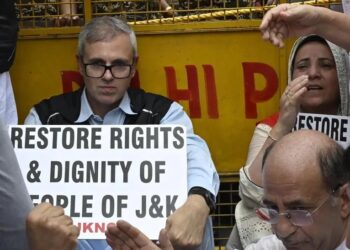
After the changes made to Kashmir’s political landscape on 5 August 2019, it appears the new hardliner chosen by the party is its parliamentarian, Agha Ruhullah Mehdi. He openly goes against the party line and accuses his own Chief Minister, Omar Abdullah, of not doing anything substantial to get back the special status, statehood and semi-autonomy that Jammu and Kashmir enjoyed till 4 August 2019.
Jammu and Kashmir is no longer a full-fledged state. It does not enjoy special status. It does not have semi-autonomy. It does not have a separate flag or a separate constitution either.
Critics within the National Conference argue that their party has backed down from obtaining and demanding pre-1953 status for Jammu and Kashmir to regional autonomy in 1999-2000 and to the restoration of statehood in 2026. Parliamentarian Mehdi is the party’s biggest and loudest critic. There are other legislators and senior party workers as well who have issues with the party leadership, especially with Chief Minister Omar Abdullah’s leadership style.
In off-the-record conversations, they admit that Omar Abdullah has failed to inspire party workers and legislators and is seen as someone who crawls when asked to bend, avoids confrontation, makes compromises and lacks the will to fight.
Be that as it may, independent critics see a pattern in the roles performed by Sheikh Nazir Ahmad, Mustafa Kamal and Ruhullah Mehdi. They argue that it is performative politics to keep the vote bank intact. It is optics to be seen as tough guys who speak truth to power (Delhi). But, in reality, they have been performing roles assigned to them by their party!